
About AIRS
Overview of The AIRS Project
This seven-year major collaborative research initiative aims to Advance Interdisciplinary Research in Singing through cooperation of over 70 researchers representing every province in Canada and 15 other countries on 6 continents. Aiming to understand individual, cultural, and universal influences on singing and the influences of singing on individuals and societies, the AIRS researchers will focus on three themes:
- Development of singing ability; (Theme 1 leader - Frank Russo, Ryerson University, Toronto)
- Singing and learning - how to teach singing and how to use singing to teach; (Theme 2 leader - Helga Gudmundsdottir, University of Iceland)
- Enhancement of health and well-being through singing. (Theme 3 leader - Susan O'Neill, University of Western Ontario)
These themes may be regarded respectively as defining what singing behaviours are theoretically possible given mental, physiological, and environmental constraints; what singing behaviours occur in practice, and what are societal implications of singing. Within and across these themes, researchers will share their knowledge and expertise from numerous disciplinary perspectives, including psychology, musicology, music therapy, education, sociology, anthropology, folklore, medicine, and audio and computer engineering. They will share their work audio-visually using a digital library and web-site, the foundations of which are already established at UPEI.
Several common motifs integrate the collaboration: an emphasis on student training opportunities; researcher meetings supported by electronic technology fostering transfer of findings across themes; and an AIRS test battery of singing skills woven through the research themes. The research results will be disseminated through traditional academic means (peer-reviewed journals, books, conferences) and through real world activities and settings (school curricula, homes for seniors, medical interventions, performances). Such dissemination will provide a foundation for decision making in education, health, culture, immigration, and foreign policy.
The Project Director is Dr. Annabel J. Cohen, University of Prince Edward Island
WHY IS THIS RESEARCH IMPORTANT?
Singing, like speaking, is a natural human expressive ability. Yet, in comparison to speaking, less scholarly inquiry has been directed to it. Linked to social, cultural, and biological development, singing draws on many disciplines and submits to many forms of analysis and specific explorations.
WHO IS INVOLVED?
An international collaboration of more than 70 scholars is integrating new multidisciplinary knowledge about singing from the perspectives of psychology, music, linguistics, sociology, anthropology and education, assisted by computer science and audio engineering.
WHAT ARE THE AREAS OF FOCUS?
AIRS will address the following three main themes from the perspective of individual, cultural, and universal influences:
Development of Singing
Acquisition of Singing: Determining through cross-cultural and longitudinal research, the universal, culture specific and idiosyncratic aspects of the development of singing.
Singing and Speaking Comparisons: Defining the features that distinguish singing and speech acquisition so as to advance linguistics, developmental psycholinguistics, music and education.
Education
Teaching Singing and Educating through Singing: Assessing and improving instructional methods for teaching and learning, and using singing to teach and learn the curricula of other disciplines.
Singing and Well-being
Cultural Understanding through Singing: Examining the role of teaching songs of foreign cultures to children to promote lifelong cultural understanding of others and themselves. This entails acquiring information about the songs of various cultures.
Intergenerational Singing: Determining how singing increases individual physical and psychological well-being and community well-being, with a special focus on intergenerational singing where elder members of a society teach children songs of their culture.
Singing and Health: Specific health benefits of singing as in breathing exercise compliance in lung disease through singing
HOW WILL KNOWLEDGE BE SHARED?
An interactive web-based virtual research environment, already in development (vre.upei.ca/AIRS) is supporting the research team, enabling discussion forums and information sharing across Canada and throughout the world. The site is hosting a one-of-a-kind comprehensive digital library database of singing that will accelerate progress on each research theme. Internet access to the AIRS database will enable multidisciplinary teams of experts and students to address the five related research themes.
WHAT IS THE EXPECTED IMPACT?
The research program will heighten the value of singing as an effective source of well-being for individuals, communities, and societies.
The digital multimedia resources will furnish cultural contexts for education and enhancing learning in general through singing.
Through broad and varied means of dissemination of the AIRS findings, the research will benefit universal education, language training, peaceful co-existence, intergenerational understanding, personal well-being, societal cohesion, and the preservation of cultural diversity.
More than 40 university students will receive training opportunities through involvement in all intellectual aspects of the work and through participation in videoconferences, workshops, and annual meetings.
AIRS will revolutionize research in singing resulting in growth of basic knowledge and advances on practical issues that will benefit the human condition.
Access to the vast new AIRS data repository of singing will advance basic knowledge by:
* Identifying universals and particulars of singing development and defining the distinctions between singing and speaking and between song and speech
* Producing pedagogy protocols for teaching singing in general, teaching songs of foreign cultures, and using singing to teach other knowledge while providing benefit of the arts,
* Improving intercultural understanding within communities and across nations
* Developing guidelines for intergenerational singing, aimed at enhancing quality of life for older adults, inspiring children, and benefiting general health for all who sing.
For further information contact:
Dr. Annabel Cohen, Department of Psychology, University of Prince Edward Island
902 628-4325 or acohen@upei.ca
AIRS Director and Principal Investigator
Professor of Psychology, University of Prince Edward Island, and Project Leader of the Institute for Interdisciplinary Research in Culture, Multimedia, Technology and Cognition
AIRS Organizational Chart
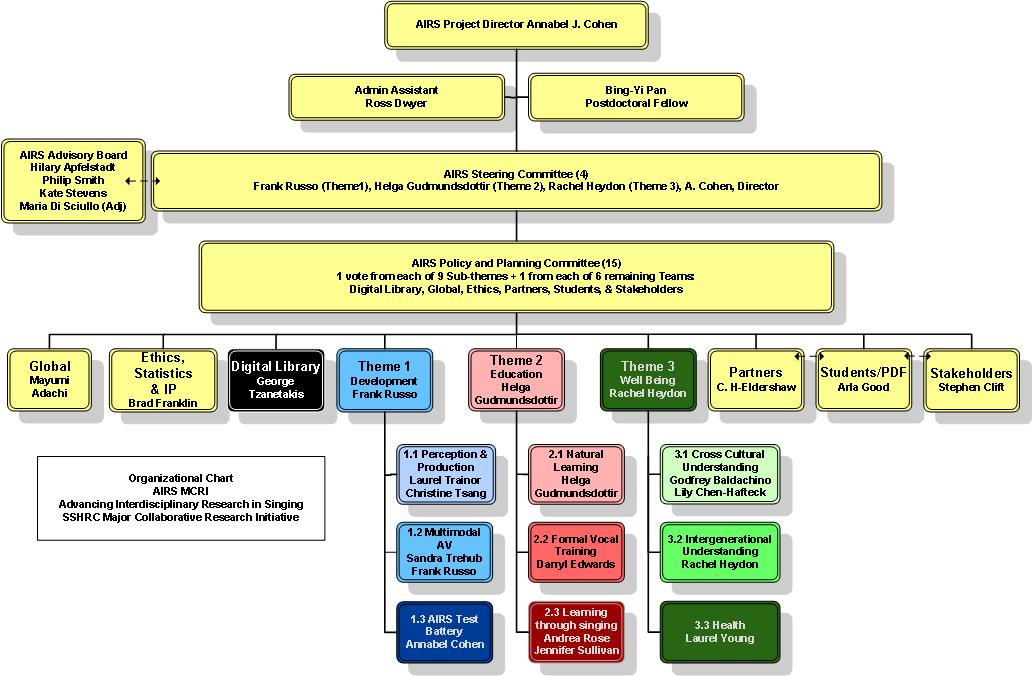
(click for Researcher Profiles of the Themes and Sub-themes)
RESEARCH THEMES & SUB-THEMES - LEADERS/CO-LEADERS
Theme 1 - DEVELOPMENT - Frank Russo
|
Sub-Theme 1.1 Perception & Production
|
Laurel Trainor, Dept. of Psychology, Neuroscience & Behaviour; Director McMaster Institute for Music & the Mind, Hamilton ON
Christine Tsang, Chair, Department of Psychology, Huron University College at the University of Western Ontario, London ON
Sub-Theme 1.2 Multimodal AV
|
Sandra Trehub, Professor Emerita, Department of Psychology, University of Toronto ON
Frank Russo, Assistant Professor, Department of Psychology, Ryerson University, Toronto ON
Sub-Theme 1.3 AIRS Test Battery
|
Annabel Cohen, AIRS Director and Principal Investigator, University of Prince Edward Island
Theme 2 - EDUCATION - Helga Gudmundsdottir
|
Sub-Theme 2.1 Natural Learning
|
Helga Gudmundsdottir, Assistant Professor in Music Education, University School of Education, University of Iceland
Sub-Theme 2.2 Formal Vocal Training
|
Darrel Edwards, Head of Voice Studies, Faculty of Music, University of Toronto ON
Carol Beynon, Faculty of Education, University of Western Ontario, London ON
Sub-Theme 2.3 Learning Through Singing
|
Andrea Rose, Artistic Director, violinist, Professor - Faculty of Music, Memorial University, Newfoundland
Jennifer Sullivan, Director, University Laboratory School, Department of Psychology, Western University, Ontario
Theme 3 - WELL BEING - Rachel Heydon
|
Sub-Theme 3.1 Cross Cultural Understanding
|
Godfrey Baldacchino, Canada Research Chair in Island Studies, University of Prince Edward Island
Lily Chen-Hafteck, Assistant Chair of Music Department, Kean University, New Jersey
Sub-Theme 3.2 Intergenerational Understanding
|
Rachel Heydon, Faculty of Education, The University of Western Ontario, London ON
Sub-Theme 3.3 Music & Health
|
Laurel Young, Creative Arts Therapies, Sunnybrook Health Sciences Centre, Toronto ON
Group content visibility:
Use group defaults
